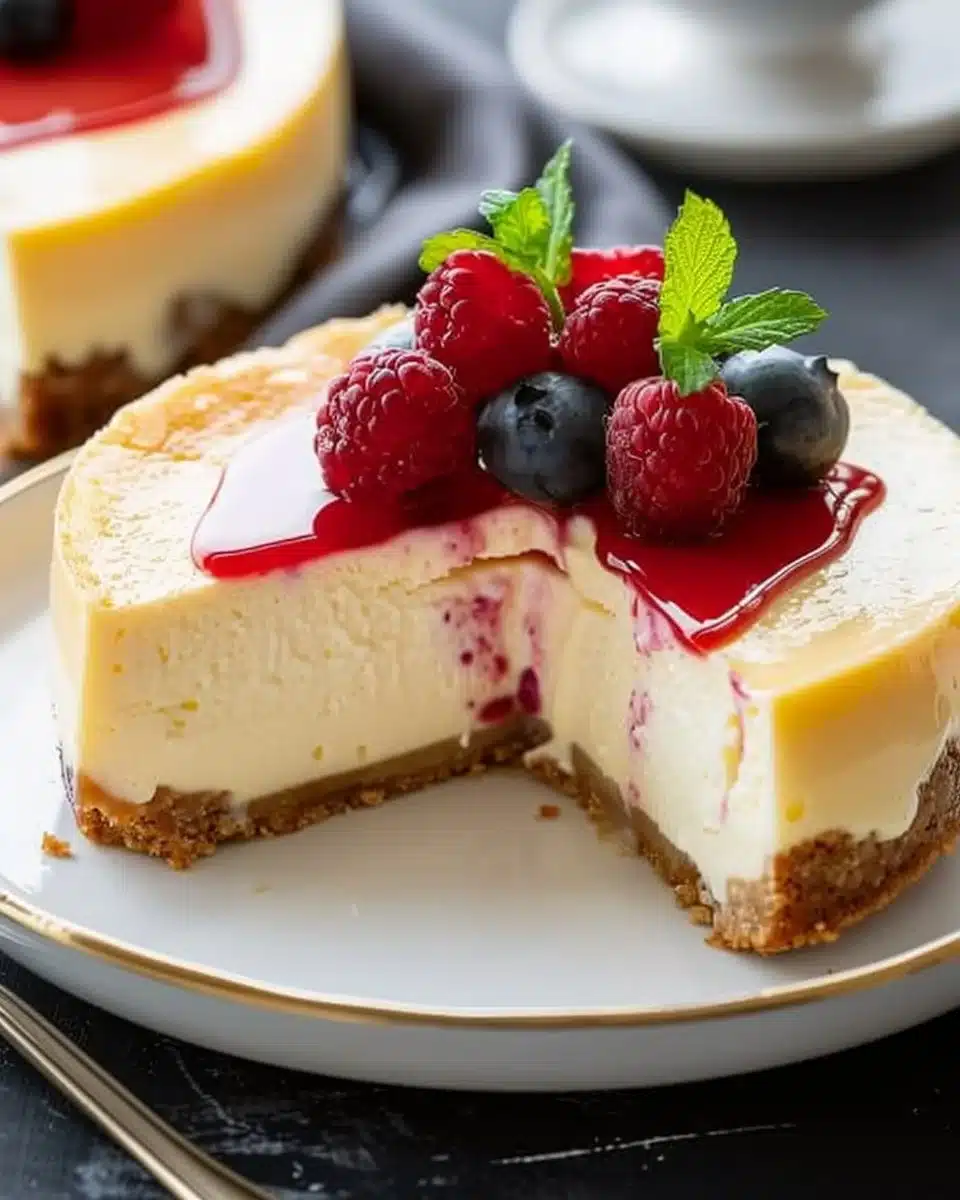
Low Carb Cheesecake with Greek Yogurt is a lighter take on the classic dessert that keeps the creamy texture you love while cutting carbs and calories.
If you’re looking to satisfy a sweet tooth without derailing a low-carb plan, this Low Carb Cheesecake with Greek Yogurt is a smart, simple choice; for a savory low-carb option to pair with weeknight meals, try this cheesy low-carb taco bake. This cheesecake balances tangy Greek yogurt and rich cream cheese, and it can be made with or without a nutty almond crust depending on your preferences. Below you’ll find why this recipe works, how to make it step by step, tips, variations, and everything you need to serve, store, and enjoy it.
Why make this recipe
This version of cheesecake is ideal if you want dessert without a large carb load or long ingredient lists. Greek yogurt brings protein and a pleasant tang, while cream cheese provides the classic richness that makes cheesecake feel indulgent. Using a sugar substitute like erythritol keeps sweetness without adding net carbs, and an almond-flour crust adds texture and a mild nutty flavor for those who want a more familiar cheesecake mouthfeel.
Beyond the nutrition benefits, this recipe is quick: the filling comes together with a few minutes of mixing, and the oven does the rest. It’s forgiving — the center can be slightly jiggly and still set nicely after cooling — and it adapts well to add-ins like berries, citrus zest, or a chocolate swirl. Finally, because many of the ingredients are pantry staples, you can usually whip this up with minimal shopping.
How to make Low Carb Cheesecake with Greek Yogurt
This recipe is designed to be approachable. Read through the full directions before you start so you know whether you’ll make a crust or not, and plan to chill the cheesecake thoroughly for the best texture.

Ingredients
- 2 cups Greek yogurt
- 1/2 cup cream cheese, softened
- 1/2 cup granulated erythritol or other low-carb sweetener (monk fruit or stevia blends also work — see notes)
- 1 teaspoon vanilla extract
- 1/4 cup lemon juice (freshly squeezed is best)
- 1/4 teaspoon salt
- 1/2 cup almond flour (for crust, optional)
- 1/4 cup butter, melted (for crust, optional)
Ingredient notes and substitutions:
- Greek yogurt: Use plain, full-fat Greek yogurt for the creamiest texture and best mouthfeel. If you prefer a lighter cheesecake, a 2% Greek yogurt will work but may result in a less rich finish. If you need a dairy-free option, try a thick coconut yogurt and adjust for sweetness and tang.
- Cream cheese: Make sure it’s softened to room temperature so it blends smoothly. Low-fat cream cheese will thin the filling slightly, so blend carefully and expect a slightly lighter texture.
- Low-carb sweeteners: Erythritol keeps carbs low and texture close to sugar. If you prefer monk fruit or a monk-fruit/erythritol blend, that’s an excellent swap. If you use a liquid sweetener like stevia, reduce the liquid content a bit and follow the conversion ratio on the package.
- Almond flour crust: Optional but adds a familiar base. If you have nut allergies, use a thin crust of toasted oat fiber mixed with melted butter or skip the crust entirely; the cheesecake holds together fine without one.
Directions
- Preheat the oven to 325°F (163°C). If making a crust, mix the almond flour and melted butter until combined, then press into the bottom of a springform pan. Bake for 10 minutes and let cool.
- In a mixing bowl, combine the Greek yogurt, cream cheese, erythritol, vanilla extract, lemon juice, and salt.
- Beat the mixture until smooth and creamy, scraping down the sides of the bowl so there are no lumps. A hand mixer or stand mixer on low to medium speed works best.
- Pour the cheesecake filling onto the cooled crust (or directly into the springform pan if no crust is used). Smooth the top with a spatula.
- Bake for 45–50 minutes, or until the center is set but slightly jiggly. The edges should be set and lightly golden; the center will firm up as it cools.
- Turn off the oven and allow the cheesecake to cool in the oven with the door ajar for about an hour. This gentle cooling helps prevent cracks.
- Refrigerate for at least 4 hours or overnight before serving. Enjoy your guilt-free low carb cheesecake!
Pro Tips for Success Low Carb Cheesecake with Greek Yogurt
- Soften ingredients to room temperature: Let the cream cheese and, if possible, the Greek yogurt sit out briefly so they blend smoothly without lumps. Cold cream cheese makes the filling uneven.
- Don’t overmix once the filling is smooth: Overbeating can incorporate too much air and cause the cheesecake to crack or sink as it cools. Mix until smooth and stop.
- Use a water bath or gentle heat trick: If you’re prone to cracked cheesecakes, place the springform pan on a shallow baking tray filled with hot water (bain-marie) or use the oven-door-ajar cooling method described in the directions. Both methods moderate oven temperature and help the cheesecake set evenly.
- Chill thoroughly: The cheesecake’s texture improves after extended refrigeration. For best slicing, chill overnight.
- Check doneness by touch, not time alone: Times vary between ovens. The center should wobble slightly but not be liquid. It will firm up while cooling.
- If you want a smoother top, run a thin knife around the edge immediately after removing the cake from the oven to prevent sticking and cracking as it cools.
Flavor Variations Low Carb Cheesecake with Greek Yogurt
- Berry swirl: Fold 1/3 cup of puréed strawberries or raspberries (sweetened with a touch of erythritol) into half the batter, spoon in layers, and swirl with a knife before baking. Fresh berries on top after chilling are a lovely finishing touch.
- Lemon or orange zest: Add the finely grated zest of one lemon or a small orange to the batter for an extra citrus pop that complements the lemon juice in the recipe. This makes the cake brighter and more aromatic.
- Chocolate-adapted: Stir 2–3 tablespoons of unsweetened cocoa powder into half of the batter and layer it with the plain portion to create a mild marble effect. Use a sugar-free chocolate topping when serving to keep carbs low.
- Nut and spice crust: Mix 1/2 cup almond flour with 1–2 teaspoons of cinnamon and a handful of crushed pecans or walnuts, then combine with melted butter for a spiced, textured base. This gives a warm, cozy twist.
Serving Suggestions Low Carb Cheesecake with Greek Yogurt
- Fresh fruit: A small handful of raspberries, blueberries, or thinly sliced strawberries add color and natural sweetness without many carbs. Serve them on top or around the slice.
- Light coulis: Warm 1/2 cup of berries with a tablespoon of water and a tablespoon of erythritol until the fruit breaks down, then strain for a smooth, sugar-free coulis to drizzle. Use sparingly to keep net carbs low.
- Whipped cream: Lightly sweeten 1/2 cup heavy whipping cream with a teaspoon of erythritol and a drop of vanilla, then whip to soft peaks and serve a dollop with each slice. This adds richness without many carbs.
- Toasted nuts: A sprinkle of chopped toasted almonds, pistachios, or walnuts gives crunch and a contrasting texture that complements the creamy filling.
- Coffee or tea pairing: Serve slices with a dark coffee or herbal tea. The bright lemon and tang from the yogurt pair particularly well with nutty or slightly acidic beverages.
Storage and Freezing Instructions Low Carb Cheesecake with Greek Yogurt
- Refrigerating: Store the cheesecake, covered tightly with plastic wrap or in an airtight container, for up to 5 days. If you slice it first, place parchment between layers to prevent sticking. Proper chilling keeps the texture creamy and prevents the crumbs from going soggy.
- Freezing whole: You can freeze the whole cheesecake wrapped securely in plastic wrap and then foil for up to 2 months. Thaw overnight in the refrigerator before unwrapping to avoid condensation making the surface soggy.
- Freezing individual slices: Freeze slices on a baking tray until firm, then wrap each slice in plastic and place them in a freezer-safe bag. This method makes it easy to defrost single portions in the fridge for several hours.
- Reheating: It’s best served chilled. If you prefer it slightly softer, leave a slice at room temperature for 15–20 minutes before serving. Avoid microwaving, which can ruin the texture.
Nutrition Facts (Per Serving) — approximate (with almond-flour crust; yields 8 servings)
- Calories: 197 kcal
- Protein: 7.5 g
- Total carbohydrates: 4.1 g
- Fat: 16.8 g
- Fiber: 0.4 g
- Sodium: 130 mg
Notes on these values:
- These figures are estimates using full-fat Greek yogurt and a crust made with 1/2 cup almond flour and 1/4 cup butter. If you omit the crust, calories and fat drop significantly (to roughly 107 kcal and 8 g fat per slice).
- Erythritol is not included in net carbs because it does not raise blood glucose the same way sugar does; if you use a different sweetener, check package nutrition to adjust.
- If you use low-fat dairy or a different crust, recalculate accordingly. For precise tracking, enter your exact brands and quantities into a nutrition calculator.
FAQ About Low Carb Cheesecake with Greek Yogurt
What makes this cheesecake low carb?
This cheesecake lowers carbs primarily by replacing granulated sugar with erythritol (or another low-carb sweetener) and by offering an optional almond-flour crust instead of a sugar-laden graham cracker base. Greek yogurt and cream cheese both contain relatively low amounts of carbs compared to desserts that rely heavily on sugar or flour. The result is a dessert that maintains a creamy, satisfying texture with a much smaller net carbohydrate count per serving.
Can I use non-fat Greek yogurt or a light cream cheese?
Yes, you can, but expect differences in texture and flavor. Non-fat Greek yogurt and reduced-fat cream cheese will produce a slightly less creamy and less rich cheesecake; the filling may be lighter and a bit more delicate when slicing. If you use lower-fat dairy, consider chilling the cheesecake longer before serving to help it set firm and improve sliceability.
How do I prevent my cheesecake from cracking?
There are several reliable techniques: make sure ingredients are at room temperature so the batter blends smoothly without lumps; avoid overmixing which introduces excess air; cool the cheesecake gradually by turning off the oven and leaving the door ajar for about an hour; and consider a water bath (placing the springform pan in a larger pan with hot water) to moderate temperature changes. These methods reduce stress on the surface and help the cake settle without cracks.
Can I make this in a different pan or as mini cheesecakes?
Yes. A 9-inch springform pan is ideal for the recipe as written, but you can use smaller pans or make mini cheesecakes in a muffin tin with liners. If using mini pans, reduce baking time (mini cheesecakes often take 20–30 minutes depending on size). Keep a close eye on doneness: the centers should still be slightly jiggly but not liquid. Cooling and chilling times may also be shorter for smaller portions.
Is this cheesecake safe for someone on a keto diet?
This cheesecake can fit a keto approach if you choose ingredients carefully (full-fat yogurt, low-carb sweetener, optional almond flour crust) and control portion size. With the almond-flour crust included, net carbs per serving are roughly 3–4 grams; without the crust, net carbs are even lower. As with any keto meal plan, track your total daily carbs and serving size to ensure it fits within your individual carb limit.
Final Thoughts
This Low Carb Cheesecake with Greek Yogurt is a flexible, crowd-pleasing dessert that makes it easier to enjoy cheesecake while keeping carbs in check. It’s creamy, tangy, and adaptable — whether you top it with bright berries, swirl in chocolate, or skip the crust for an even lower carb count. The recipe is friendly for weeknight baking and also scales for entertaining when you need a make-ahead dessert that still feels special. Try it once as written, then experiment with one of the flavor variations to make it your own.
Print
Low Carb Cheesecake with Greek Yogurt
- Total Time: 65 minutes
- Yield: 8 servings 1x
- Diet: Low Carb, Keto
Description
A lighter take on classic cheesecake using Greek yogurt and low-carb sweeteners, perfect for satisfying a sweet tooth without the carbs.
Ingredients
- 2 cups Greek yogurt
- 1/2 cup cream cheese, softened
- 1/2 cup granulated erythritol or other low-carb sweetener
- 1 teaspoon vanilla extract
- 1/4 cup lemon juice
- 1/4 teaspoon salt
- 1/2 cup almond flour (for crust, optional)
- 1/4 cup butter, melted (for crust, optional)
Instructions
- Preheat the oven to 325°F (163°C). If making a crust, mix the almond flour and melted butter until combined, then press into the bottom of a springform pan. Bake for 10 minutes and let cool.
- In a mixing bowl, combine Greek yogurt, cream cheese, erythritol, vanilla extract, lemon juice, and salt.
- Beat the mixture until smooth and creamy, scraping down the sides of the bowl.
- Pour the cheesecake filling onto the cooled crust or directly into the springform pan. Smooth the top with a spatula.
- Bake for 45–50 minutes, until the center is set but slightly jiggly. The edges should be set and lightly golden.
- Turn off the oven and let the cheesecake cool in the oven with the door ajar for about an hour.
- Refrigerate for at least 4 hours or overnight before serving.
Notes
For best results, chill overnight for improved texture. Use a water bath for even baking and to prevent cracking.
- Prep Time: 15 minutes
- Cook Time: 50 minutes
- Category: Dessert
- Method: Baking
- Cuisine: American
Nutrition
- Serving Size: 1 serving
- Calories: 197
- Sugar: 0g
- Sodium: 130mg
- Fat: 16.8g
- Saturated Fat: 7g
- Unsaturated Fat: 9.8g
- Trans Fat: 0g
- Carbohydrates: 4.1g
- Fiber: 0.4g
- Protein: 7.5g
- Cholesterol: 30mg