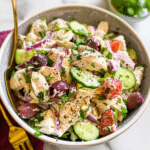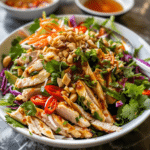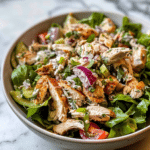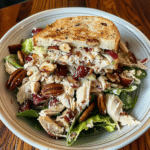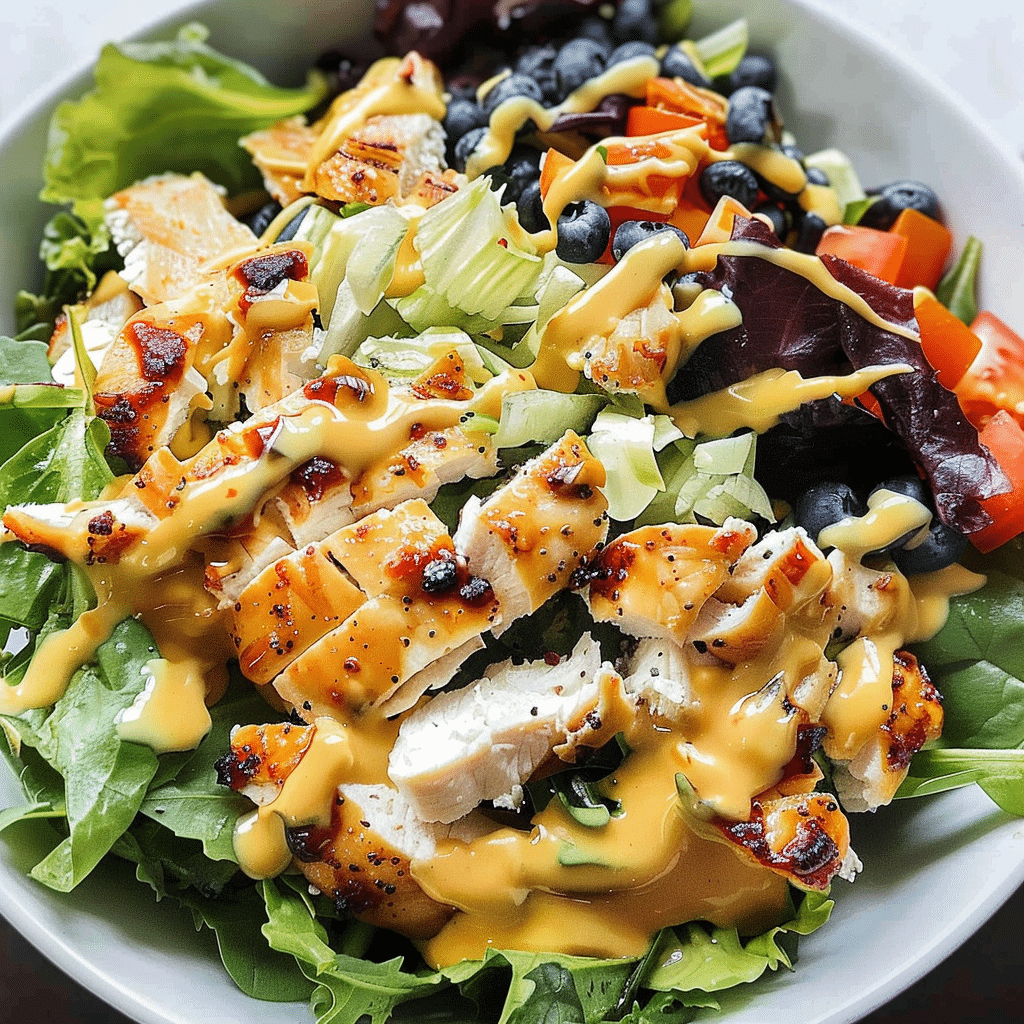
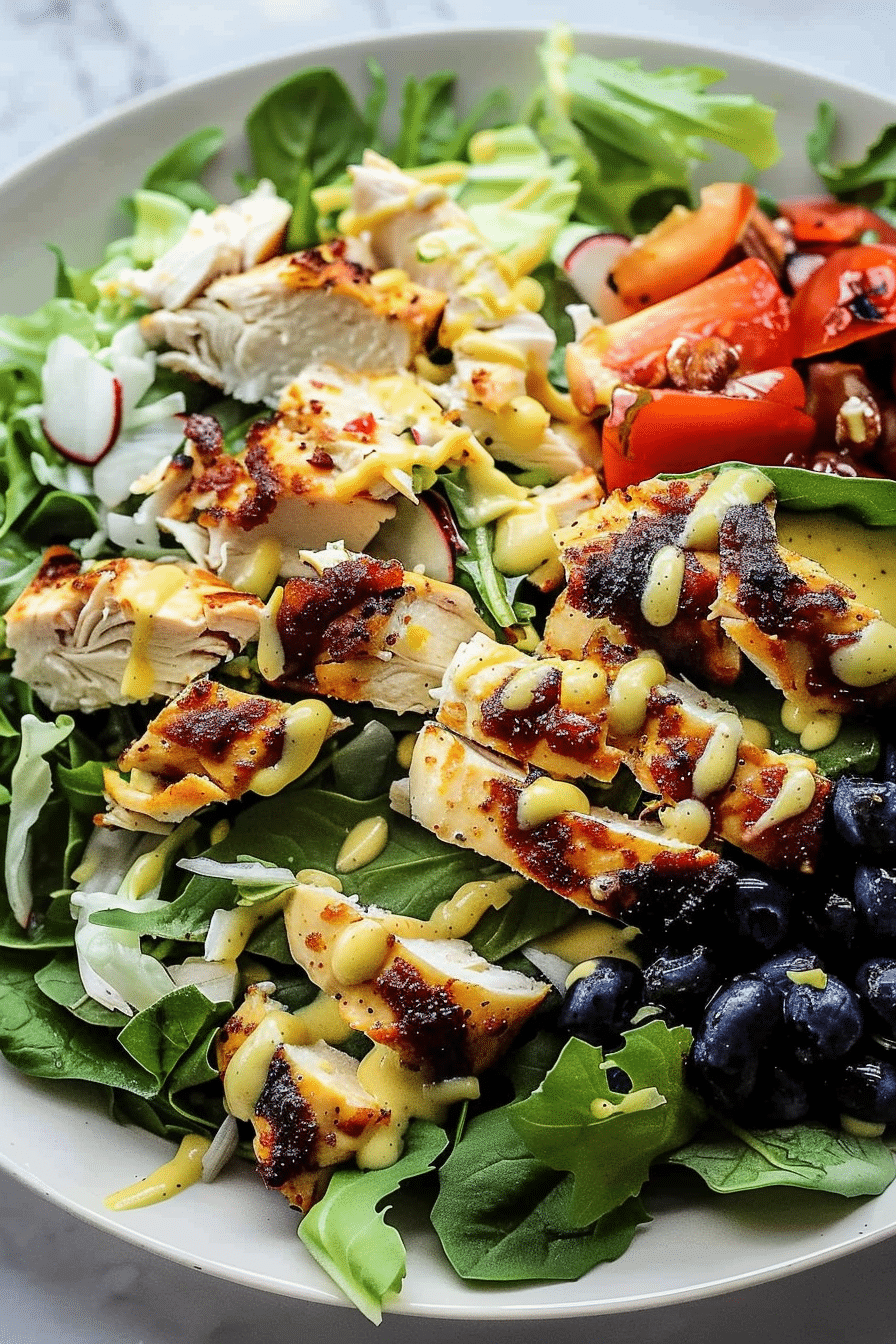
Honey mustard chicken salad combines tender poached chicken breasts with a creamy yogurt-based dressing, fresh blueberries, gorgonzola cheese, and sliced almonds for a balanced, protein-rich meal. This salad delivers the perfect balance of sweet, savory, and tangy flavors while remaining simple enough for weeknight dinners. The honey mustard dressing clings to crisp romaine lettuce and creates a satisfying lunch option that tastes restaurant-quality but takes under 30 minutes from start to finish.
| Prep Time | 15 minutes |
| Cook Time | 15 minutes |
| Total Time | 30 minutes |
| Servings | 4 |
| Difficulty | Easy |
| Cuisine | American |
Why This Recipe Works
I developed this honey mustard chicken salad after years of ordering mediocre versions at lunch spots. The key is poaching the chicken instead of grilling it, which keeps the meat incredibly moist and tender while absorbing subtle seasoning from the broth. This technique beats other cooking methods because you retain every drop of moisture and create a delicate texture that contrasts beautifully with the crunchy almonds and crisp romaine.
The dressing separates this salad from ordinary versions because it relies on Greek yogurt instead of heavy mayonnaise, cutting calories while amplifying the tanginess that complements the honey sweetness. The combination of yellow and Dijon mustard creates dimensional flavor rather than one-note sharpness. I specifically chose blueberries and dried cranberries because their natural tartness prevents the salad from becoming cloying, even with the honey in the dressing.
Gorgonzola cheese adds a sophisticated blue cheese element that sophisticated palates recognize, but its funk balances perfectly against the sweet honey mustard profile. This ingredient combination reflects restaurant plating principles while remaining accessible for home cooks. The salad actually tastes better after two hours when flavors marry together, making it ideal for meal prep.
Ingredients
| Ingredient | Quantity | Notes |
|---|---|---|
| Boneless skinless chicken breasts | 4 | About 6-8 oz each; use room temperature for even cooking |
| Soy sauce (or tamari) | 1/4 cup | Use tamari or coconut aminos for gluten-free option |
| Extra virgin olive oil | 2 tablespoons | Substitute avocado oil for higher smoke point |
| Worcestershire sauce | 2 teaspoons | Adds umami depth; use vegetarian variety if preferred |
| Garlic (minced) | 2 teaspoons | Fresh garlic; avoid pre-minced jar versions for better flavor |
| Lemon juice | 1 teaspoon | Fresh-squeezed; bottled works in a pinch |
| Plain Greek yogurt | 3/4 to 1 cup | Use dairy-free coconut yogurt or cashew cream alternative |
| Yellow mustard | 2 tablespoons | Standard yellow creates mild sweetness |
| Dijon mustard | 2 tablespoons | Adds sophisticated sharpness; whole grain works too |
| Honey | 2 to 3 tablespoons | Raw honey preferred; use agave nectar for vegan option |
| Lemon zest | 1 teaspoon | Bright citrus notes; use microplane for finest texture |
| Kosher salt | Pinch | Taste and adjust; sea salt alternative works equally |
| Ground black pepper | Pinch | Freshly ground tastes superior to pre-ground |
| Romaine lettuce (chopped) | 4 cups | Substitute mixed greens or baby spinach if preferred |
| Blueberries | 1 1/2 cups | Fresh or frozen; thaw frozen ones before adding |
| Gorgonzola cheese (crumbled) | 1 cup | Blue cheese or feta cheese work as substitutes |
| Slivered almonds | 1 cup | Lightly toast for enhanced nutty flavor |
| Crumbled chicken bacon | 1 cup | Use turkey bacon or coconut bacon for alternative proteins |
| Dried cranberries (or cherries) | 1/2 cup | Add tartness; dried blueberries or raisins substitute well |
Step-by-Step Instructions
Preparing the Poaching Liquid
- Combine 1/4 cup soy sauce, 2 tablespoons olive oil, 2 teaspoons Worcestershire sauce, 2 teaspoons minced garlic, and 1 teaspoon fresh lemon juice in a large skillet or shallow pot.
- Add 2 cups water and bring the mixture to a gentle simmer over medium heat.
- Let the liquid heat for 2 minutes so flavors infuse fully before adding the chicken.
Cooking the Chicken
- Place all four boneless skinless chicken breasts into the simmering liquid once small bubbles appear at the edges.
- Reduce heat to medium-low so the liquid barely bubbles rather than rolling at a vigorous boil.
- Cover the skillet partially with a lid and poach for 12 to 15 minutes, depending on thickness.
- Insert an instant-read thermometer into the thickest part of the largest breast, ensuring it reaches exactly 165 degrees Fahrenheit for safe consumption.
- Transfer the cooked chicken to a cutting board and let it rest for 5 minutes before cutting into bite-sized pieces.
Making the Honey Mustard Dressing
- Combine 3/4 to 1 cup plain Greek yogurt, 2 tablespoons yellow mustard, 2 tablespoons Dijon mustard, and 2 to 3 tablespoons honey in a medium bowl.
- Add 1 teaspoon lemon zest, a pinch of kosher salt, and a pinch of ground black pepper.
- Whisk the dressing thoroughly until it reaches a smooth, uniform consistency with no lumps remaining.
- Taste the dressing and adjust honey or mustard levels based on your preference for sweetness versus tanginess.
Assembling the Salad
- Arrange 4 cups chopped romaine lettuce evenly across four serving plates or a large platter.
- Top the lettuce with the poached chicken pieces distributed equally among servings.
- Scatter 1 1/2 cups fresh blueberries across the lettuce and chicken base.
- Sprinkle 1 cup crumbled gorgonzola cheese over the berries in generous handfuls.
- Add 1 cup slivered almonds and 1/2 cup dried cranberries across all portions.
- Top each plate with 1 cup crumbled chicken bacon distributed evenly for smoky crunch.
- Drizzle the honey mustard dressing generously over the assembled salad just before serving.
Chef Tips for Perfect Results
- Poach chicken at a gentle simmer between 160 to 180 degrees Fahrenheit rather than a rolling boil, which dries out the meat and causes it to become tough and stringy instead of tender.
- Toast the slivered almonds in a dry skillet for 3 to 4 minutes over medium heat, shaking frequently until fragrant and golden, which concentrates their nutty flavor and adds textural contrast.
- Prepare the honey mustard dressing up to 2 days ahead and refrigerate it in an airtight container, allowing flavors to meld and intensify while saving preparation time on serving day.
- Cut the chicken breasts into consistent bite-sized pieces about 1 inch square, ensuring even distribution throughout the salad and preventing large chunks that dominate individual bites.
- Pat blueberries and other ingredients completely dry before adding to the salad to prevent excess moisture from diluting the dressing and making lettuce soggy.
- Use room-temperature chicken breasts for poaching because they cook more evenly than cold ones straight from the refrigerator, reducing the risk of overcooked edges and undercooked centers.
Common Mistakes to Avoid
Overcooking the Chicken: Cooking chicken breasts above 165 degrees Fahrenheit causes proteins to seize and expel moisture, creating dry, rubbery texture. Fix this by using an instant-read thermometer and removing chicken the moment it hits the target temperature, allowing carryover cooking during the 5-minute rest period.
Using Boiling Instead of Simmering Liquid: A rolling boil breaks down the delicate chicken structure and creates an agitated surface that prevents even cooking. Instead, maintain a gentle simmer where small bubbles occasionally break the surface, typically between 160 to 180 degrees Fahrenheit on your thermometer.
Adding Dressing Too Early: Combining the dressing with salad components more than 15 minutes before serving causes the romaine to wilt and lose crispness as the liquid breaks down cell walls. Mix the dressing in just before plating or serve it on the side so diners control the moisture level.
Skimping on the Mustard Balance: Using only one type of mustard creates a one-dimensional sharpness rather than the sophisticated layered flavor that yellow and Dijon mustard together provide. Combine both varieties so the yellow mustard’s sweetness complements the Dijon’s complex spice notes.
Omitting the Lemon Zest: Many home cooks skip the lemon zest thinking juice alone provides citrus flavor, but zest delivers bright aromatic oils that juice cannot. The tiny pieces distribute throughout the dressing and create bursts of fresh flavor that prevent the salad from tasting heavy or monotonous.
Variations and Substitutions
| Ingredient | Substitution | Impact on Flavor |
|---|---|---|
| Greek yogurt | Cashew cream or dairy-free coconut yogurt | Maintains creaminess and tang; adds subtle nutty or tropical undertones |
| Blueberries | Raspberries or blackberries | Increases tartness; darker berries add earthiness and deeper color |
| Gorgonzola cheese | Blue cheese, feta, or goat cheese | Blue cheese intensifies funk; feta adds saltiness; goat cheese softens intensity |
| Slivered almonds | Candied pecans or walnuts | Pecans add buttery richness; walnuts introduce earthy bitterness |
| Chicken bacon | Turkey bacon or crispy shallots | Turkey bacon offers milder smoke; shallots add sweet caramelized depth |
| Dried cranberries | Dried cherries or dried apricots | Cherries maintain tartness; apricots increase sweetness and tropical notes |
| Romaine lettuce | Spinach, arugula, or mixed greens | Spinach adds earthiness; arugula introduces peppery bite; mixed greens blend flavors |
| Honey | Agave nectar or pure maple syrup | Agave maintains sweetness with neutral profile; maple adds woodsy complexity |
Serving Suggestions and Pairings
Serve honey mustard chicken salad as the centerpiece for summer lunch gatherings or elegant outdoor brunches where guests appreciate sophisticated flavor combinations. Pair it with crusty sourdough bread and a crisp white wine alternative like sparkling apple cider for complete meal satisfaction. This salad works perfectly for meal prep containers when you layer components separately, keeping lettuce crisp and dressing fresh throughout the week.
Present the salad on chilled plates for warm weather occasions or serve family-style in a large wooden bowl for casual gatherings where everyone selects their ideal portion. Accompany with grilled marinated vegetable skewers or roasted sweet potato wedges for additional substance. The honey mustard chicken salad also serves as an excellent filling for whole grain wraps or pita pockets when you omit the lettuce base and focus on the protein and accompaniments.
For office lunch situations, pack the salad components in separate containers and assemble just before eating to maintain maximum texture and freshness. Drizzle dressing on the side so you control moisture levels throughout the meal. This approach also makes the salad travel-friendly for picnics and outdoor events where traditional mixed salads tend to become soggy and unappetizing during transport.
Storage and Reheating
| Method | Duration | Instructions |
|---|---|---|
| Refrigerator (assembled) | 1 to 2 hours maximum | Cover with plastic wrap; only assemble shortly before serving to prevent wilting and sogginess |
| Refrigerator (components separate) | 3 to 4 days | Store cooked chicken, lettuce, cheese, and nuts in separate airtight containers; combine just before eating |
| Honey mustard dressing | Up to 5 days | Keep in sealed glass jar; shake vigorously before each use as yogurt settles naturally |
| Poached chicken alone | Up to 4 days | Store in airtight container; reheat gently in microwave for 1 to 2 minutes until warm, or eat cold |
| Freezer (cooked chicken) | Up to 3 months | Portion into freezer bags or containers; thaw overnight in refrigerator before using in fresh salad |
| Freezer (assembled salad) | Not recommended | Freezing damages lettuce texture and causes mushiness upon thawing; store components separately instead |
Nutritional Information
Approximate values per serving (one-quarter of recipe with all ingredients included)
| Nutrient | Amount per Serving |
|---|---|
| Calories | 620 to 680 |
| Protein | 48 to 52 grams |
| Total Fat | 35 to 40 grams |
| Saturated Fat | 8 to 10 grams |
| Carbohydrates | 28 to 32 grams |
| Dietary Fiber | 5 to 7 grams |
| Sugars | 16 to 18 grams |
| Sodium | 850 to 950 milligrams |
Frequently Asked Questions
Can I use mayonnaise instead of Greek yogurt in the honey mustard dressing?
Mayonnaise creates a heavier, richer dressing that masks the delicate chicken flavor and honey mustard complexity. Greek yogurt maintains creaminess while the tangy culture adds brightness that complements the sweet-savory profile perfectly. If you substitute mayonnaise, increase the lemon zest and lemon juice quantities by 50 percent to maintain adequate tang.
How do I know when the poached chicken reaches perfect doneness?
Insert an instant-read thermometer into the thickest part of the largest breast, ensuring it reads exactly 165 degrees Fahrenheit at the center. Visual cues like white color fool home cooks because pale chicken can still be undercooked, so always verify with a thermometer. Remove chicken immediately upon reaching 165 degrees because continued cooking causes dryness and toughness.
What if the honey mustard dressing turns out too thick?
Thin overly thick dressing by whisking in 1 tablespoon of water at a time until you reach the desired consistency that coats the back of a spoon. If the dressing becomes too thin, add more Greek yogurt in 1 tablespoon increments. Refrigerated dressing thickens as it sits, so account for this when adjusting consistency immediately after preparation.
Can I make the honey mustard chicken salad a day ahead for meal prep?
Store the cooked chicken, chopped lettuce, dressing, and toppings in separate airtight containers for up to four days without quality loss. Assemble only the portion you plan to eat because pre-mixed salads wilt and the dressing dilutes the lettuce texture. This method actually improves flavor because components marinate separately and develop depth overnight.
What’s the best way to serve honey mustard chicken salad for a crowd?
Arrange all salad components on a large platter family-style so guests customize their portions based on personal preferences. Place the honey mustard dressing in a separate bowl with a small ladle, allowing people to control moisture levels. This presentation prevents soggy salad from sitting in dressing for extended periods and ensures maximum crispness and textural contrast.
Conclusion
Honey mustard chicken salad delivers sophisticated restaurant-quality flavors with straightforward technique that works for both everyday lunches and special occasions. The poached chicken stays incredibly moist while the creamy yogurt-based dressing balances sweet honey with tangy mustard complexity. Master this recipe and you’ll return to it repeatedly for meal prep, entertaining, and any situation demanding a satisfying, nutritious meal that tastes far more impressive than the minimal effort required.
Print
Honey Mustard Chicken Salad
- Total Time: 30
- Yield: 4 servings 1x
- Diet: Non-Vegetarian
Description
A restaurant-style salad featuring tender poached chicken breasts, fresh blueberries, and a creamy Greek yogurt dressing with honey and mustard. This American classic balances sweet, savory, and tangy flavors in under 30 minutes.
Ingredients
4 boneless, skinless chicken breasts
1 cup plain Greek yogurt
2 tablespoons honey
2 tablespoons yellow mustard
1 tablespoon Dijon mustard
1 clove garlic, minced
1 head romaine lettuce, chopped
1 cup fresh blueberries
1/4 cup dried cranberries
1/2 cup crumbled gorgonzola cheese
1/4 cup sliced almonds
1 teaspoon lemon juice
Salt and pepper to taste
Instructions
Poach chicken breasts in a pot of salted, low-sodium chicken broth with herbs (thyme, bay leaf) for 15 minutes or until internal temperature reaches 165°F.
Let chicken rest for 5 minutes, then slice into strips.
In a small bowl, combine Greek yogurt, honey, yellow mustard, Dijon mustard, minced garlic, lemon juice, and a pinch of salt to form the dressing.
In a large salad bowl, layer chopped romaine lettuce, fresh blueberries, dried cranberries, and sliced almonds.
Top with sliced poached chicken and crumbled gorgonzola cheese.
Pour the dressing over the salad and gently toss to coat.
Adjust salt and pepper to taste.
Serve immediately, ideally with a few extra sliced almonds for garnish.
Notes
Use unsweetened cranberries to control sugar content.
For a dairy-free alternative, use vegan yogurt and omit gorgonzola.
Fresh herbs like parsley or dill can enhance the dressing.
Store leftovers for up to 24 hours (best served fresh).
- Prep Time: 15
- Cook Time: 15
- Category: trends
- Method: Poaching
- Cuisine: American
Nutrition
- Serving Size: 1 serving
- Calories: 410
- Sugar: 15g
- Sodium: 600mg
- Fat: 28g
- Saturated Fat: 12g
- Carbohydrates: 25g
- Fiber: 3g
- Protein: 30g
- Cholesterol: 110mg